

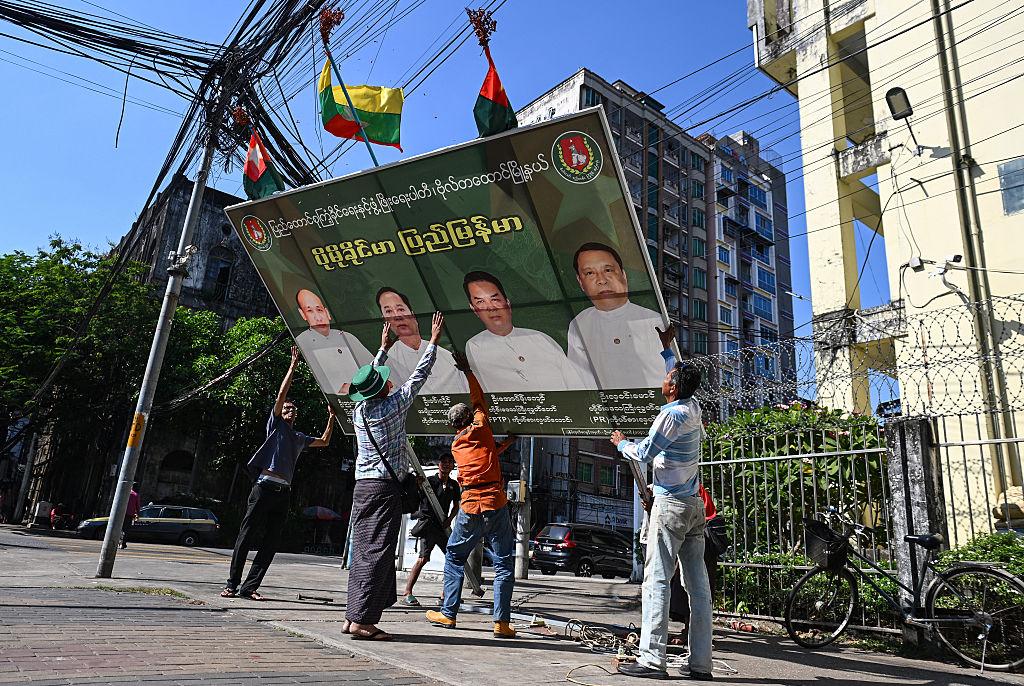
Myanmar’s military-backed political party has been declared the overwhelming victor in the country’s latest general election, a vote widely criticized by international observers and human rights organizations as lacking credibility, inclusiveness, and basic democratic standards.
According to official results released by the Union Election Commission (UEC), the Union Solidarity and Development Party (USDP) secured 739 of the 1,025 seats contested across national and regional legislatures. The result effectively guarantees the party control over the next government and reinforces the Myanmar military’s continued dominance over the country’s political system.
A Predictable Outcome in a Controlled Political Environment
The scale of the USDP’s victory came as little surprise. The election was conducted in three stages—December 28, January 11, and January 25—under conditions that critics argue were designed to ensure a predetermined outcome.
Myanmar has remained under military rule since the February 2021 coup, which overturned the results of the 2020 general election. Since then, political space has been sharply restricted, independent media outlets dismantled, and opposition activity criminalized under expanded national security and public order laws.
While 57 political parties were reportedly registered to participate, meaningful competition was absent. The political landscape was fundamentally altered by the dissolution of the National League for Democracy (NLD), the party led by Aung San Suu Kyi that won landslide victories in both 2015 and 2020.
Marginal Opposition Gains
Official UEC figures show that the National Unity Party, a successor to the former Burma Socialist Programme Party, finished a distant second with 68 seats, followed by the Shan and Nationalities Democratic Party, which won 39 seats. The remaining seats were divided among smaller parties, most of them ethnic-based groups contesting limited constituencies in specific states or regions.
Large portions of the country—particularly areas experiencing active armed conflict—did not participate in the vote at all. Entire townships in Chin, Kachin, Sagaing, Karenni, and Rakhine states were excluded on security grounds, effectively disenfranchising millions of citizens.
Election Condemned as a “Sham”
The conduct and legitimacy of the election drew swift criticism from international observers. Tom Andrews, the United Nations Special Rapporteur on the situation of human rights in Myanmar, described the process as a “theatrical performance designed to dupe the international community.”
According to Andrews and other observers, voters faced intense pressure to participate, while criticism of the process was punishable under newly enacted laws. State-controlled media dominated election coverage, leaving little room for dissenting views or independent reporting.
The absence of genuine political competition, combined with severe restrictions on civil liberties, led many analysts to conclude that the vote served primarily to provide a veneer of civilian legitimacy to continued military rule.
Consolidation of Legislative Power
With its decisive parliamentary majority, the USDP will dominate both houses of the legislature at the national level as well as state and regional assemblies. This dominance enables the party to appoint a president, form a cabinet, and shape key legislation without meaningful opposition.
Myanmar’s parliament, the Pyidaungsu Hluttaw, is expected to convene in the third week of March, according to statements by junta leader Min Aung Hlaing.
On the same day the election timeline was confirmed, Min Aung Hlaing approved legislation creating a powerful new governing body known as the Union Consultative Council.
New Council Expands Centralized Control
According to reporting by Reuters, the five-member Union Consultative Council will wield exceptionally broad authority over national security, governance, and the legislative process. Members of the Council will be appointed by the president and serve five-year terms aligned with the presidential mandate.
Legal analysts cited by Reuters suggested that the Council’s structure could allow Min Aung Hlaing to retain decisive influence over state affairs regardless of whether he formally assumes the presidency. The arrangement may also provide a mechanism for continued military oversight under a nominally civilian administration.
Conflict and Humanitarian Crisis Persist
Despite official claims that the election represents a step toward political stability, conditions on the ground suggest otherwise. Armed resistance groups continue to control or contest large areas of the country, and fighting between junta forces and opposition groups remains widespread.
The Armed Conflict Location & Event Data (ACLED) stated that the elections have “done nothing to bridge the divide between the military and the hundreds of resistance groups opposing its rule.” The organization warned of “enduring instability and competing authorities across the nation.”
ACLED estimates that at least 93,300 people have been killed since the 2021 coup, underscoring the scale of the humanitarian and security crisis facing Myanmar.
International Recognition Remains Uncertain
While junta officials have promoted the election as a path toward international normalization, many governments and multilateral organizations remain skeptical. The absence of key political actors, widespread disenfranchisement, and ongoing conflict are likely to limit diplomatic recognition of the new government.
For Myanmar’s population, the election changes little in daily reality. Economic hardship, displacement, and insecurity continue to shape life across much of the country, while prospects for inclusive political dialogue remain remote.
Outlook
The USDP’s electoral victory formally advances the military’s plan to entrench its authority through institutional mechanisms rather than overt emergency rule. However, without addressing the underlying political grievances and armed resistance that dominate Myanmar’s post-coup landscape, the transition risks reinforcing division rather than resolving it.
As Myanmar enters another chapter of tightly controlled governance, the gap between official narratives of stability and conditions on the ground continues to widen—raising serious questions about the country’s political future.