

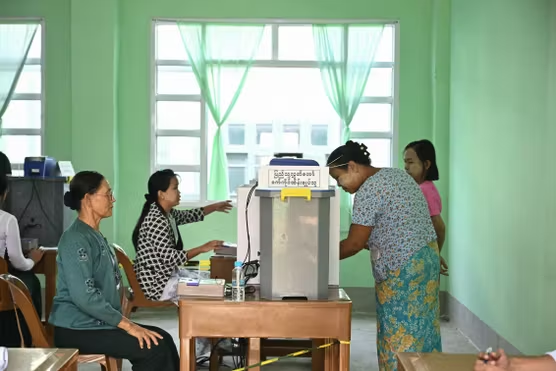
Myanmar Pro-Junta Party Claims Election Victory Amid UN Criticism
Myanmar’s dominant pro-military political party has claimed victory in junta-run elections widely dismissed by the United Nations and democracy watchdogs as an attempt to legitimize continued army rule. A senior official from the Union Solidarity and Development Party (USDP) told Agence France-Presse (AFP) on Monday, January 26, that the party had already secured a parliamentary majority following a month-long voting process.
Official results are expected later this week, but critics argue that the outcome was effectively predetermined due to the exclusion of key opposition groups, widespread conflict, and strict controls imposed by the military authorities.
Background: Military Rule Since the 2021 Coup
Myanmar’s military seized power in February 2021, overthrowing the elected civilian government led by Aung San Suu Kyi and ending a decade-long experiment with partial democracy. The coup sparked nationwide protests, followed by a brutal crackdown and the outbreak of a multi-front civil war involving ethnic armed organizations and newly formed resistance groups.
Since then, the junta has promised a “roadmap to democracy,” centered on a three-phase electoral process that it claims would return power to the people. However, international observers and local civil society groups have consistently questioned the credibility of this pledge.
USDP Claims Majority Win
According to the USDP official, who spoke on condition of anonymity due to restrictions on sharing preliminary results, the party is now positioned to form a new government.
“We won a majority already,” the official said. “We are in the position to form a new government. As we won in the election, we will move forward.”
The USDP reportedly secured strong results in the first two phases of the election, held on December 28 and January 11, with the final phase concluding on Sunday.
Many analysts describe the USDP as a civilian proxy for the military. The party is staffed largely by retired senior officers and has historically served as the armed forces’ political vehicle during previous periods of military rule.
Structural Advantage for the Military
Even under the current electoral framework, the military retains substantial power. Under Myanmar’s 2008 constitution, which was drafted during an earlier period of junta rule, 25 percent of parliamentary seats are reserved for unelected military appointees.
Once parliament convenes in March, lawmakers from both chambers will elect the president. With guaranteed military representation and a USDP majority, critics argue that the process ensures continued dominance by the armed forces regardless of voter turnout or public opinion.
Min Aung Hlaing Keeps Options Open
On Sunday, junta leader Min Aung Hlaing toured polling stations in Mandalay dressed in civilian clothing. While doing so, he again declined to rule out assuming the presidency under the new government structure.
His potential appointment would further reinforce claims that the election is merely a rebranding exercise designed to provide military rule with a veneer of civilian legitimacy.
Opposition Excluded, Voting Limited
The election took place in deeply constrained conditions. Voting was canceled in approximately one in five townships due to ongoing fighting between the military and resistance forces. Large areas of the country remain outside junta control, effectively disenfranchising millions of citizens.
Aung San Suu Kyi remains detained, and her National League for Democracy (NLD), which won more than 90 percent of parliamentary seats in the 2020 election, was dissolved and barred from participating. According to the Asian Network for Free Elections, parties that dominated the last democratic vote were entirely absent from the ballot.
Pre-Election Crackdown and Alleged Abuses
In the lead-up to the polls, conflict monitors reported an escalation in military operations, including airstrikes and ground assaults in contested regions. Human rights organizations allege that some of these actions may constitute war crimes.
Within junta-controlled areas, dissent has been systematically suppressed. New laws impose penalties of up to 10 years in prison for protesting, criticizing the election, or questioning its legitimacy.
As of this month, more than 22,000 people are reportedly being held in detention for political reasons, according to the Assistance Association for Political Prisoners.
International Response and UN Condemnation
The United Nations and several Western governments have repeatedly stated that the election does not meet international standards for free and fair voting.
UN special rapporteur Tom Andrews warned that global acceptance of the election would undermine efforts to resolve Myanmar’s crisis.
“While the election results within Myanmar have never been in doubt, the election result that matters most is the response of the international community,” Andrews said last week. “International acceptance of this fraudulent exercise would set back the clock on genuine resolution to this crisis.”
ASEAN, of which Myanmar is a member, remains divided on how to respond, while China and Russia have taken a more cautious stance, emphasizing stability over political reform.
Outlook: Legitimacy Still in Question
Despite the junta’s claims of victory, the election is unlikely to bring an end to Myanmar’s civil war or political turmoil. Rebel groups have already rejected the results, and analysts say the conflict is likely to continue regardless of the new government’s composition.
For many Myanmar citizens and international observers, the vote represents not a return to democracy, but a consolidation of military power under a different name.
FAQs (5–7)
1. Who won Myanmar’s recent election?
The pro-military Union Solidarity and Development Party (USDP) has claimed a majority victory, though official results have not yet been released.
2. Why is the election considered controversial?
The election excluded major opposition parties, including Aung San Suu Kyi’s dissolved NLD, and was not held in large parts of the country due to conflict.
3. What role does the military play in parliament?
Under Myanmar’s constitution, 25% of parliamentary seats are reserved for unelected military representatives.
4. Will Min Aung Hlaing become president?
Junta leader Min Aung Hlaing has not ruled out serving as president once parliament convenes.
5. How has the UN responded to the election?
The UN has strongly criticized the vote, calling it fraudulent and warning against international recognition.
6. Did voting occur nationwide?
No. Elections were canceled in about one-fifth of townships, particularly in conflict-affected areas.
7. Will the election end Myanmar’s civil war?
Most analysts believe the election will not stop the conflict, as resistance groups reject its legitimacy.