

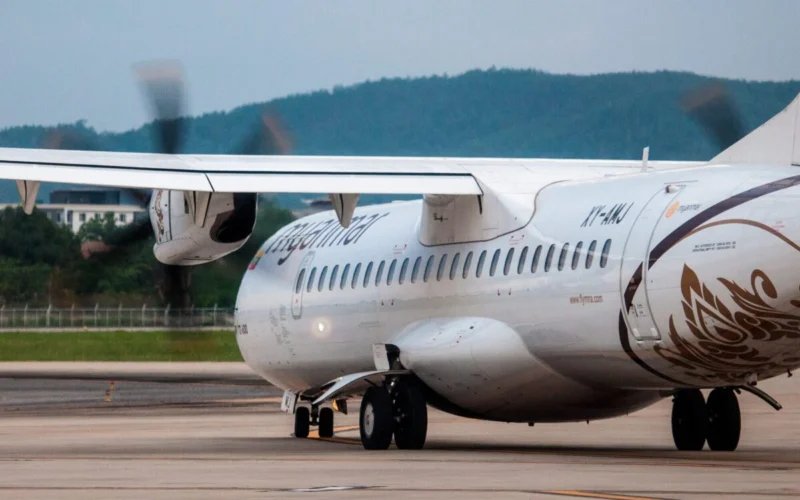
An ATR 72-600 operated by Myanmar National Airlines was struck by First-Person View (FPV) drones during an evening attack at Myitkyina Airport, highlighting the escalating risks to civilian aviation amid Myanmar’s ongoing civil conflict.
According to media reports, the attack occurred at approximately 8:12 p.m. local time. Several drones reportedly targeted the airport area. While some were believed to have been intercepted, at least two drones struck the turboprop aircraft. The drones were allegedly equipped with RPG-type warheads, raising serious concerns about the increasing sophistication of non-state actors in the conflict.
Fortunately, no casualties were reported. However, footage circulating on social media shows significant structural damage to the aircraft.
What Happened at Myitkyina Airport?
At the time of the incident, the ATR72-600 was being boarded by passengers ahead of its scheduled departure to Mandalay International Airport. The aircraft was positioned on the tarmac when multiple drones approached the airport perimeter.
Reports indicate:
- Several drones were launched toward airport facilities.
- At least two drones impacted the aircraft.
- Warheads were reportedly RPG-type, capable of penetrating metal fuselage structures.
- Damage occurred in multiple sections of the aircraft.
Despite the severity of the strike, no passengers or crew were injured. The absence of casualties is remarkable given the proximity of boarding operations and the explosive nature of the munitions.
Damage Assessment: Where the Aircraft Was Hit
Preliminary visual analysis from online footage suggests damage in three main areas:
1. Frontal Section (Near Cockpit)
The forward fuselage area adjacent to the cockpit windows appears to have sustained visible blast damage. While cockpit penetration has not been officially confirmed, structural compromise near avionics systems is significant.
2. Mid-to-Rear Fuselage
Blast markings and puncture damage were visible along the rear fuselage section. The structural integrity of this segment is critical for pressurization and stability.
3. Underside Near the Tail
A portion beneath the tail assembly appeared pierced, possibly affecting structural frames or control system linkages.
Even without casualties, such damage could potentially render the aircraft beyond economical repair depending on the severity of internal structural compromise.
About the ATR 72-600
The ATR 72-600 is a twin-engine turboprop regional airliner designed for short-haul operations. Built by ATR (Aerei da Trasporto Regionale), the aircraft is widely used across Asia, Europe, and Africa for domestic and regional routes.
Key characteristics:
- Capacity: 68–72 passengers
- Engines: Pratt & Whitney Canada PW127M
- Typical Range: ~1,500 km
- Cruise Speed: ~510 km/h
- Designed for short runways and regional connectivity
Myanmar National Airlines operates eight ATR72-600 aircraft alongside two leased Boeing 737-800 jets. The ATR fleet primarily serves domestic destinations across Myanmar, including Yangon, Mandalay, Myitkyina, and other regional airports.
The Growing Threat of FPV Drone Warfare
FPV drones—small, highly maneuverable unmanned aerial vehicles piloted remotely via live video feed—have transformed modern asymmetric warfare. Originally popularized in hobbyist racing communities, these drones have been adapted for military use in multiple global conflicts.
What makes FPV drones particularly dangerous:
- Low cost and accessible components
- Difficult to detect via traditional radar
- Ability to carry explosive payloads
- High maneuverability and precision targeting
The reported use of RPG-type warheads suggests increasing technical adaptation by armed groups within Myanmar’s civil war environment.
Civil Aviation in a Conflict Zone
Myanmar has been embroiled in armed conflict since the military takeover in 2021. Numerous ethnic armed organizations and resistance groups have been engaged in clashes with the central government across multiple states, including Kachin State.
The attack has been attributed in some reports to the Kachin Independence Organisation (KIA). However, a spokesperson for the organization reportedly denied involvement.
Regardless of attribution, the incident marks a significant escalation:
- Civilian aircraft were targeted during boarding.
- Explosive drones were deployed against aviation infrastructure.
- The attack occurred at an operational airport, not a military base.
This raises broader questions about the safety of domestic air travel within Myanmar.
Impact on Myanmar National Airlines
As the state-owned flag carrier, Myanmar National Airlines plays a crucial role in maintaining domestic connectivity, particularly in remote regions.
The airline’s ATR fleet is central to:
- Linking Kachin, Chin, and Shan States to major cities
- Facilitating medical and emergency transport
- Supporting government and commercial mobility
Damage or grounding of aircraft reduces available capacity, potentially disrupting:
- Scheduled domestic routes
- Tourism recovery efforts
- Cargo and essential supply transport
Insurance implications could also be substantial. War-risk insurance premiums for airlines operating in conflict zones typically rise sharply following such incidents.
Aviation Security Concerns
Airports in conflict-affected regions face increasing vulnerability to drone-based attacks. Traditional perimeter fencing and runway security were designed for ground threats, not low-altitude aerial incursions.
Challenges include:
- Detecting small drones in urban or mountainous terrain
- Deploying counter-drone systems without disrupting civilian flights
- Preventing weaponized UAV access to airport airspace
This event may prompt:
- Enhanced counter-drone defenses at Myanmar airports
- Flight schedule adjustments
- Increased international aviation advisories
Strategic and Political Implications
The attack underscores the evolving dynamics of Myanmar’s civil war:
- Civilian infrastructure is increasingly exposed.
- Armed groups are employing modern drone tactics.
- Aviation and transport sectors are becoming indirect targets.
Even if unintended, the targeting of a passenger aircraft—especially during boarding—represents a dangerous threshold. Such incidents can have international ramifications if foreign nationals are involved or if airspace security is deemed compromised.
Passenger Safety and Response
That no injuries occurred is likely due to:
- Timing of impact during ground operations
- Possible evacuation procedures
- Luck regarding detonation angles
Passengers reportedly disembarked safely. Airport authorities likely initiated emergency protocols, including:
- Tarmac clearance
- Fire suppression readiness
- Security lockdown
The psychological impact on passengers and crew, however, should not be underestimated.
Insurance and Financial Consequences
Aircraft damage assessment categories typically include:
- Cosmetic structural repair
- Major structural overhaul
- Total hull loss
Given visible fuselage penetration, structural repair may be extensive. If declared a hull loss, replacement costs for an ATR72-600 could exceed $25–30 million depending on age and market valuation.
War-risk insurance clauses may determine financial liability.
Broader Risk to Myanmar’s Aviation Sector
Myanmar’s aviation industry has already faced:
- Post-pandemic recovery challenges
- Reduced international connectivity
- Economic instability
An attack of this nature:
- Deters passenger confidence
- Raises operational risk
- Increases insurance and security costs
Domestic carriers may face operational scaling challenges if threats persist.
Conclusion
The drone strike on the ATR72-600 at Myitkyina Airport marks a concerning escalation in Myanmar’s ongoing civil war. While no casualties were reported, the visible damage to a civilian aircraft during passenger boarding highlights the growing vulnerability of civil aviation infrastructure.
As drone warfare evolves, airports operating in conflict-affected regions face new security challenges. Whether this incident remains isolated or signals a broader trend will significantly influence Myanmar’s aviation stability moving forward.
For Myanmar National Airlines and the broader domestic travel network, maintaining safety, confidence, and operational continuity will be critical in the months ahead.
Frequently Asked Questions (FAQs)
1. What aircraft was attacked in Myanmar?
An ATR 72-600 turboprop operated by Myanmar National Airlines was struck by explosive FPV drones.
2. Were there any casualties?
No casualties were reported despite serious visible structural damage to the aircraft.
3. Where did the attack occur?
The attack occurred at Myitkyina Airport in Kachin State while passengers were boarding for a flight to Mandalay.
4. Who was responsible for the attack?
Some reports attributed the attack to the Kachin Independence Organisation (KIA), but the group reportedly denied involvement.
5. What is an FPV drone?
An FPV (First-Person View) drone is a remotely piloted unmanned aircraft controlled via live video feed, sometimes modified to carry explosive payloads.
6. How could this affect air travel in Myanmar?
The incident may lead to increased security measures, higher insurance costs, and potential flight disruptions, especially in conflict-affected regions.