

ASEAN Does Not Recognise Myanmar’s Elections Claimed by Military Party
The Association of Southeast Asian Nations (ASEAN) has confirmed that it does not recognise Myanmar’s recent elections, which a military-backed party has claimed to have won. The statement delivers a significant setback to Myanmar’s ruling generals as they seek regional and international legitimacy following the 2021 military coup.
The announcement was made on January 29 in Cebu, Philippines, during ASEAN’s first major ministerial meetings of the year. The Philippines, currently holding ASEAN’s rotating chairmanship, placed the Myanmar crisis high on the agenda.
ASEAN’s Firm Position on Myanmar Elections
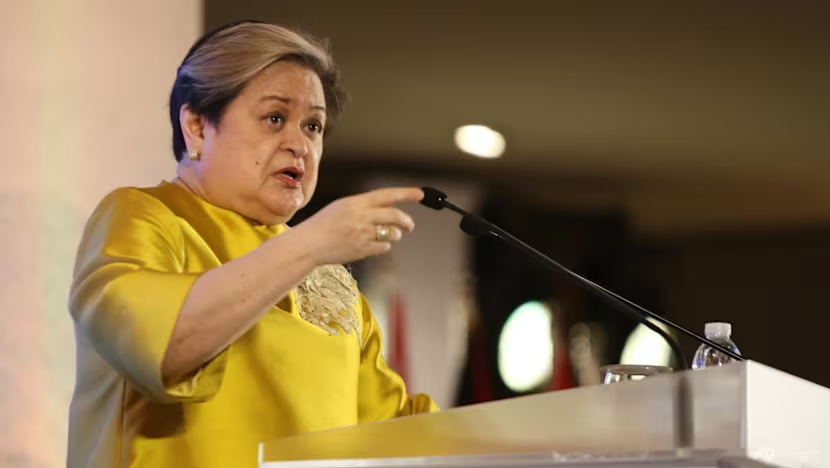
Philippine Foreign Secretary Theresa Lazaro explicitly confirmed ASEAN’s stance when asked whether the bloc recognised Myanmar’s elections.
“Yes, as of now,” Lazaro said, adding that ASEAN “has not endorsed the three phases of the elections that were held.”
This clear rejection underscores ASEAN’s continued refusal to legitimise Myanmar’s military-led political roadmap, which critics widely describe as undemocratic and exclusionary.
Since the army seized power from Aung San Suu Kyi’s elected government in February 2021, ASEAN has declined to formally recognise the junta-appointed administration, citing the ongoing political crisis and widespread violence.
Military-Backed Party Claims Victory
Myanmar’s Union Solidarity and Development Party (USDP), closely aligned with the military, claimed victory in the elections earlier this week. The party is led by former generals and has historically functioned as the military’s political arm.
However, the outcome was widely anticipated due to strict controls imposed during the voting process:
- Major opposition parties were barred or dismantled
- Political dissent was severely restricted
- 25% of parliamentary seats remain constitutionally reserved for the military
These structural guarantees effectively ensure continued military dominance regardless of election results.
Elections Criticised as Neither Free Nor Fair
Domestic critics, opposition groups, and international observers argue that the elections were designed to legitimise military rule, not reflect the will of the people.
Myanmar has remained embroiled in a deadly civil war since the coup, with armed resistance groups, ethnic militias, and pro-democracy forces clashing with junta troops across the country. Millions have been displaced, and the humanitarian crisis continues to worsen.
ASEAN’s refusal to recognise the elections signals that the regional bloc does not view the process as a credible path toward stability or reconciliation.
ASEAN Chairmanship and Myanmar’s Suspension
The Philippines assumed ASEAN’s rotating chairmanship this year—a role Myanmar was originally scheduled to hold. Myanmar was suspended from chairing ASEAN following the coup, reflecting the bloc’s unprecedented move to exclude a member state’s military leadership from high-level summits.
Founded in 1967 during the Cold War, ASEAN consists of 11 diverse members, ranging from democratic nations like the Philippines to authoritarian governments such as Laos and Cambodia.
The bloc has long struggled to maintain unity on contentious political issues, particularly when internal conflicts involve one of its own members.
Regional Challenges Beyond Myanmar
The Myanmar crisis is not the only issue straining ASEAN unity. Ministers meeting in Cebu also addressed:
- Renewed border clashes between Thailand and Cambodia
- Rising tensions in the South China Sea
- Ongoing negotiations with China on a long-delayed “code of conduct”
China’s expansive territorial claims overlap with those of four ASEAN members:
The Philippines, Malaysia, Vietnam, and Brunei.
ASEAN ministers reiterated their commitment to international law and restraint amid growing geopolitical pressure from both Washington and Beijing.
Balancing Major Powers and Regional Stability
In her opening remarks, Lazaro highlighted the delicate diplomatic balance ASEAN must maintain.
“Across our region, we continue to see tensions at sea, protracted internal conflicts and unresolved border and humanitarian concerns.”
She warned that unilateral actions—both within and beyond Southeast Asia—risk eroding the rules-based international order that ASEAN depends on for regional stability.
What ASEAN’s Rejection Means for Myanmar
ASEAN’s refusal to recognise Myanmar’s elections represents a major diplomatic blow to the military-backed government. Without regional endorsement, the junta’s efforts to regain legitimacy face serious obstacles.
While Lazaro did not outline conditions under which ASEAN’s stance might change, the message from Cebu was clear: elections conducted without inclusivity, freedom, and fairness will not be accepted as legitimate.
For Myanmar’s military rulers, regional isolation appears set to continue.
❓ Frequently Asked Questions (FAQ)
1. Does ASEAN recognise Myanmar’s recent elections?
No. ASEAN has explicitly stated that it does not recognise the elections claimed by Myanmar’s military-backed party.
2. Who claimed victory in Myanmar’s elections?
The military-aligned Union Solidarity and Development Party (USDP) claimed to have won the vote.
3. Why does ASEAN reject the elections?
ASEAN cited lack of inclusivity, exclusion of opposition parties, and the military’s guaranteed parliamentary control.
4. When did Myanmar’s military seize power?
The military seized power in February 2021, overthrowing the elected government of Aung San Suu Kyi.
5. Who currently chairs ASEAN?
The Philippines holds ASEAN’s rotating chairmanship for this year.
6. Are the elections considered free and fair?
No. Critics say the elections were designed to legitimise military rule rather than reflect democratic choice.
7. Has ASEAN recognised Myanmar’s junta government?
No. ASEAN has refused to formally recognise the military-led government since the coup.