

Nepal Donates $350,000 for Reconstruction of Damaged Religious Sites in Myanmar
In a significant gesture of regional solidarity and cultural partnership, the Government of Nepal has donated $350,000 to support the reconstruction of two religious heritage sites in Myanmar that were damaged by a powerful earthquake last March. The assistance highlights the deep historical, spiritual, and diplomatic ties between Nepal and Myanmar.
The funds were officially handed over during a ceremony in Mandalay and represent Nepal’s commitment to preserving shared religious heritage across borders.
Official Handover at Mahamuni Pagoda Complex
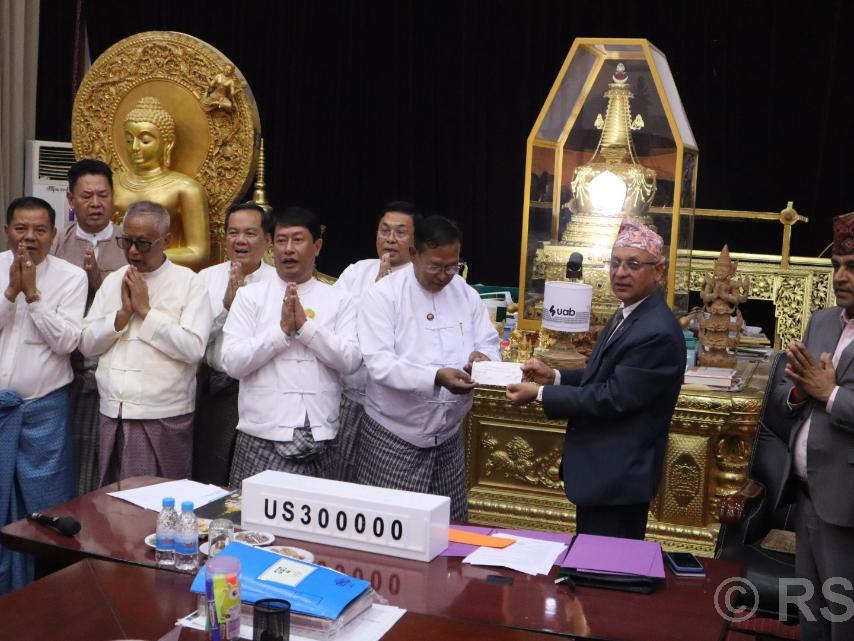
The formal ceremony took place at the historic Mahamuni Pagoda complex in Mandalay, one of Myanmar’s most sacred Buddhist sites. The Nepali Embassy in Yangon confirmed that Nepal’s Ambassador to Myanmar, Hari Shrestha Ghimire, presented a check for $300,000 to Than Oo, Secretary-General of the Pagoda.
The Mahamuni Pagoda, located in southwestern Mandalay, houses the revered Mahamuni Buddha image — a statue deeply venerated by Buddhists throughout Myanmar. The site attracts thousands of pilgrims daily and plays a central role in the country’s spiritual life.
The earthquake that struck Myanmar in March caused structural damage to portions of the complex, prompting urgent calls for preservation funding. Nepal’s contribution will help restore damaged structures, protect sacred relics, and ensure the continued functioning of the site for worshippers and visitors.
Support for Gangaghat Hindu Temple
In addition to the Mahamuni Pagoda donation, Ambassador Ghimire handed over $50,000 for the reconstruction of the Gangaghat Hindu Temple. The check was received by the temple’s chairman, Pawan Bajoria.
The Gangaghat Temple serves as a significant religious center for the Nepali and Hindu communities living in Myanmar. For decades, it has functioned as both a spiritual sanctuary and a cultural gathering space.
Damage caused by the earthquake disrupted regular worship and community events. The reconstruction funding will help restore structural integrity, repair religious icons, and safeguard the temple for future generations.
A Reflection of Shared Religious Heritage
Nepal and Myanmar share longstanding religious and cultural connections rooted in Buddhism and Hinduism. Nepal, the birthplace of Lord Buddha, and Myanmar, a predominantly Buddhist nation, maintain strong spiritual ties that transcend diplomacy.
This financial support reflects more than humanitarian assistance — it represents:
- Regional solidarity in times of natural disaster
- Commitment to cultural preservation
- Strengthening of Nepal–Myanmar diplomatic relations
- Protection of shared religious heritage
According to the statement issued by the Nepali Embassy, the donation underscores Nepal’s dedication to helping restore culturally significant sites affected by natural calamities.
Earthquake Impact on Religious Heritage
Myanmar frequently experiences seismic activity due to its position along major tectonic fault lines. The March earthquake caused damage to multiple heritage structures, particularly in Mandalay and surrounding areas.
Religious monuments in Myanmar are not only places of worship but also repositories of art, architecture, and centuries-old craftsmanship. Restoration efforts are therefore essential for:
- Preserving historical architecture
- Maintaining tourism revenue
- Protecting sacred artifacts
- Sustaining community identity
The Mahamuni Pagoda and Gangaghat Temple reconstruction projects are expected to involve structural repairs, conservation work, and reinforcement measures to mitigate future earthquake risks.
Nepal–Myanmar Diplomatic Relations
Nepal and Myanmar maintain friendly diplomatic ties supported by cultural exchange and religious cooperation. The Nepali community in Myanmar has historically played an important role in trade and social life.
This donation further strengthens bilateral relations, especially during a period when Myanmar faces significant internal challenges and infrastructure recovery needs.
For Myanmar, international support for cultural preservation carries symbolic importance. It signals global recognition of the country’s religious heritage and encourages further collaboration.
Cultural Preservation in Times of Crisis
Natural disasters often threaten cultural landmarks across Asia. When religious sites are damaged, communities experience not only physical loss but also emotional and spiritual disruption.
Reconstruction efforts provide:
- Restoration of faith-based gathering spaces
- Economic activity for local artisans
- Preservation of identity
- Symbolic hope during recovery
Nepal’s donation demonstrates how regional neighbors can support each other in safeguarding shared traditions.
What Happens Next?
Reconstruction work is expected to proceed in phases:
- Structural assessment and safety inspections
- Restoration planning and architectural evaluation
- Skilled artisan engagement
- Gradual reopening of restored sections
Authorities have indicated that transparency and preservation standards will guide the reconstruction process.
FAQs
1. How much did Nepal donate for reconstruction in Myanmar?
Nepal donated a total of $350,000, with $300,000 allocated to Mahamuni Pagoda and $50,000 to Gangaghat Hindu Temple.
2. Why is Mahamuni Pagoda important?
Mahamuni Pagoda is one of Myanmar’s most sacred Buddhist sites and houses a highly revered Buddha image visited by thousands of pilgrims.
3. Who received the donation on behalf of the pagoda?
Than Oo, Secretary-General of Mahamuni Pagoda, received the $300,000 check during the ceremony.
4. What is the significance of Gangaghat Temple?
Gangaghat Temple is an important religious site for the Nepali and Hindu community residing in Myanmar.
5. Why did Nepal provide financial support?
The donation reflects Nepal’s commitment to preserving shared religious heritage and supporting disaster-affected cultural sites.
6. When did the earthquake occur?
The earthquake occurred in March and caused damage to multiple religious and heritage structures in Myanmar.
7. Will the sites reopen soon?
Reconstruction is expected to proceed in stages. Authorities aim to restore and reopen sections as work is completed.
Conclusion
Nepal’s $350,000 donation marks a meaningful step in preserving Myanmar’s religious heritage following earthquake damage. By supporting both a major Buddhist landmark and a Hindu temple serving the Nepali diaspora, Nepal reinforces cultural solidarity and regional friendship.
For Myanmar, the reconstruction of these sacred sites represents resilience — ensuring that faith, tradition, and history endure beyond natural disasters.